
Guide
Noises That Mean Something
Wheaton homes built 1938-2003 carry original hardware that ages predictably in cold-climate swings. Here's what each noise means and when to worry.
Local detail
What to Check
Most houses in this part of the county went up between 1938 and 2003, with the bulk of the stock dating to the 1960s and 70s. That matters because a door installed on a 1968 build has had five decades of temperature swings to work on the same springs, rollers, and hinges - unless someone's already swapped them. Start by watching the door move through a full cycle. A grinding sound near the top of travel usually means a roller that's worn its bearing out, common on the older galvanized rollers that came standard on houses from that era. A sharp bang when the door closes is almost always the door hitting an out-of-square track, and on a house pushing 50 or 60 years old, the track has had time to shift with the foundation settling.
Listen for a rhythmic click as the door travels - that's a roller hitting a bent section of track, once per rotation. Squealing on the way up points to a dry hinge pivot; squealing on the way down that gets worse points to a spring under uneven tension. None of this is exotic. It's just what happens to hardware that's been cycling twice a day for decades in a cold-climate region. Check first, then decide if it's a five-minute fix or a call.
The area
What the Weather Here Does to It
This area sits in a cold, moderate climate band, which means the door hardware goes through real freeze-thaw cycles every winter rather than staying at one steady temperature. Steel springs contract in the cold and the torsion tension shifts slightly with the season - a door that closed quiet in August can start groaning by January because the spring is now carrying a bit more load than the opener was tuned for. Lubricant thickens in cold garages, especially unheated ones, which is why a hinge that was silent in summer starts to chirp once temperatures drop. On the older housing stock common here, from the 1960s and 70s, the tracks were often bolted straight to wood framing that moves with humidity and frost.
That slow seasonal shift is what turns a straight track slightly crooked over the years, and a crooked track is what makes a door bang or drag instead of gliding. None of this is a defect - it's just what cold-climate cycling does to hardware that's original or close to it. The noise is the wear announcing itself before it becomes a stuck door.
What we find
When Waiting Is Fine
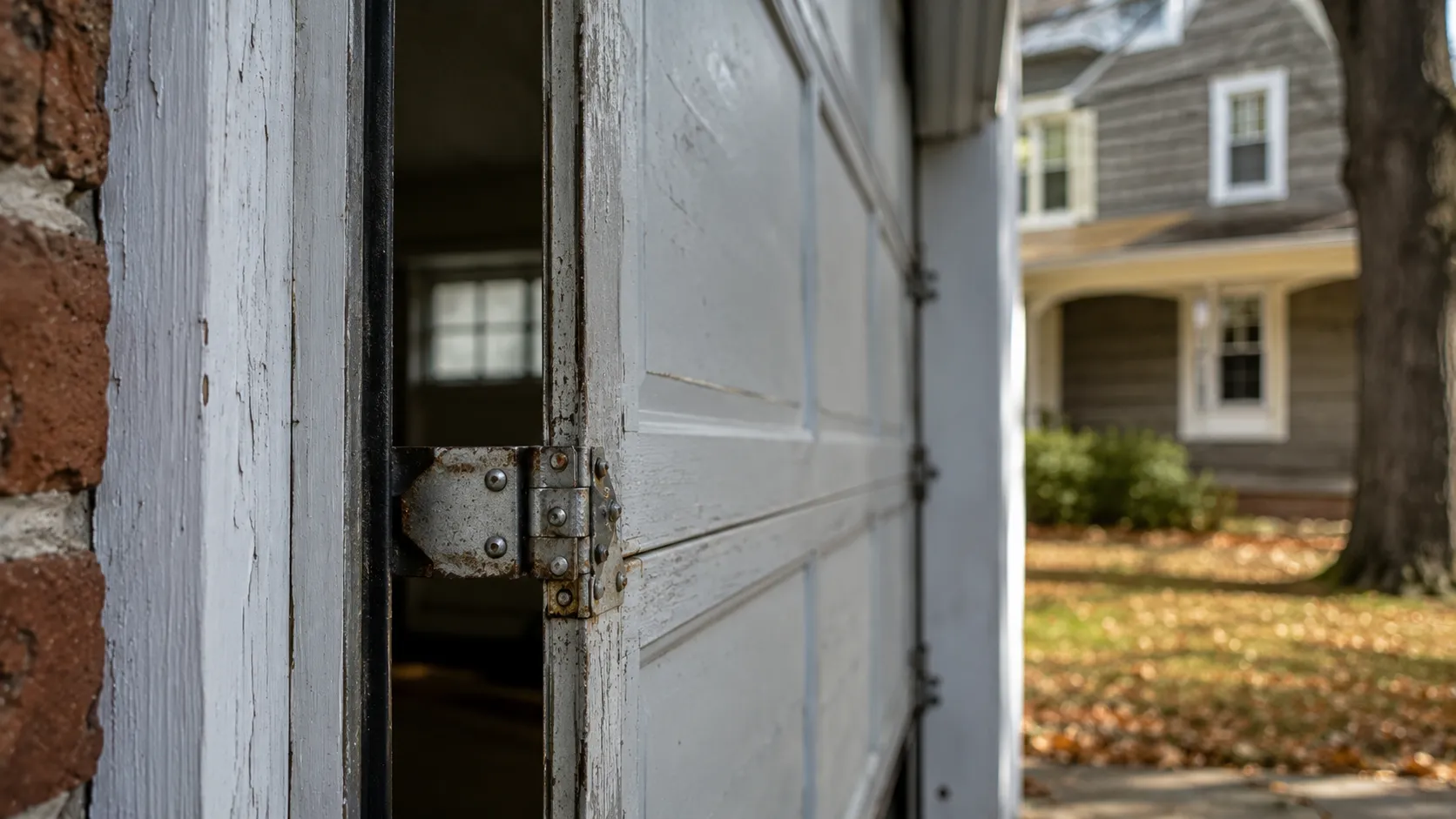
Not every noise needs a same-week call. A single squeak on a hinge that's otherwise moving smooth is a lubrication problem, not a repair - spray it, run the door ten times, and see if it quiets down. A rattly opener chain on an older unit is usually just slack that needs a quarter-turn adjustment, something plenty of owners handle themselves. If the noise is new, occasional, and the door still opens and closes flat and square, you've got time to watch it for a week or two rather than book a truck.
Where waiting isn't fine: any noise paired with the door jerking, hesitating mid-travel, or one side dropping faster than the other. That's a spring or cable losing tension unevenly, and on a door with springs original to a decades-old house, that can go from noisy to broken in the time it takes the next cold morning to arrive. We'll say plainly: we don't recommend DIY torsion spring work - the tension involved has hurt people, and it's one job worth the call regardless of how minor it sounds.
How we work
What Is Going On
Put it together and the noise is diagnostic, not decorative. A house built in the median year around here, 1976, is now old enough that its original hardware has outlived its expected service life by a wide margin, and the sound is the hardware telling you where the wear concentrated. Grinding lives in the rollers, banging lives in the track alignment, squealing lives in the hinges or spring tension, and clicking lives in a bent spot the roller keeps finding.
Because so much of the stock in the 89 named areas we work across shares that same 1960s-70s build window, we hear the same handful of noise patterns over and over - it's not random, it's the housing stock aging on a predictable schedule. If you want a second opinion on what a specific sound means before you decide whether it waits or not, that's a quick conversation, not a sales pitch.
Questions
Common questions
My door squeaks only in winter - is that normal?
Yes, and it's common on houses in this cold, moderate climate band. Lubricant thickens and spring tension shifts slightly with temperature, so a quiet summer door can pick up a seasonal squeak. Lubricate hinges and rollers first; if the squeal comes with jerky movement, that's tension-related and worth a call.
Is a banging noise on close serious?
It depends on the source. On a lot of the 1960s-70s houses around here, a bang usually means the track has shifted slightly out of square over the decades. That's a track adjustment, not an emergency, unless the door is also binding or dropping unevenly on one side.
How old does hardware need to be before noise means real wear?
There's no fixed number, but original hardware on a house from the median build year around 1976 has had a long run through cold-climate cycling. That's decades past what springs and rollers are rated for, so noise on a door that old deserves more attention than noise on a recent install.
Can I fix a noisy roller myself?
Rollers themselves are a reasonable DIY swap on most doors - nylon replacements are cheap and the job doesn't involve stored spring tension. What we don't recommend touching yourself is anything involving the torsion spring itself; that part has hurt people and isn't worth the risk.
Ready when you are
Need a garage door sorted in Wheaton?
Wheaton Garage Door Pros repairs and installs garage doors, springs and openers in Wheaton, IL and the surrounding area.