
Guide
What We Look At Before We Touch a Wrench
A look at what Wheaton Garage Door Pros checks first on a service call, tied to the age of local doors and the cold winters that wear them down.
Local detail
What to Check
Most houses around here went up between 1938 and 2003, with the median landing around 1976, and the bulk of that stock is 1960s and '70s construction. That matters because a door built for a house from that era usually still has its original torsion hardware, even if the door skin itself has been swapped out once or twice since. First thing we look at is whether the spring, drum, and shaft are original to the house or a mismatched replacement bolted on later - mismatched setups are common in homes this age and they're the number one reason a door lifts unevenly.
Next we check the track alignment, since houses built before slab-and-frame standardization sometimes have garages that have settled a little, which throws tracks out of plumb over decades. We also check roller wear and cable fray at the drum, both of which show their age faster on original 1970s-era hardware than on anything installed in the last ten years. Panel condition comes last, because on a door this old the panel is rarely the actual problem - it's almost always the moving parts underneath holding on past their working life.
The area
What the Weather Here Does to It
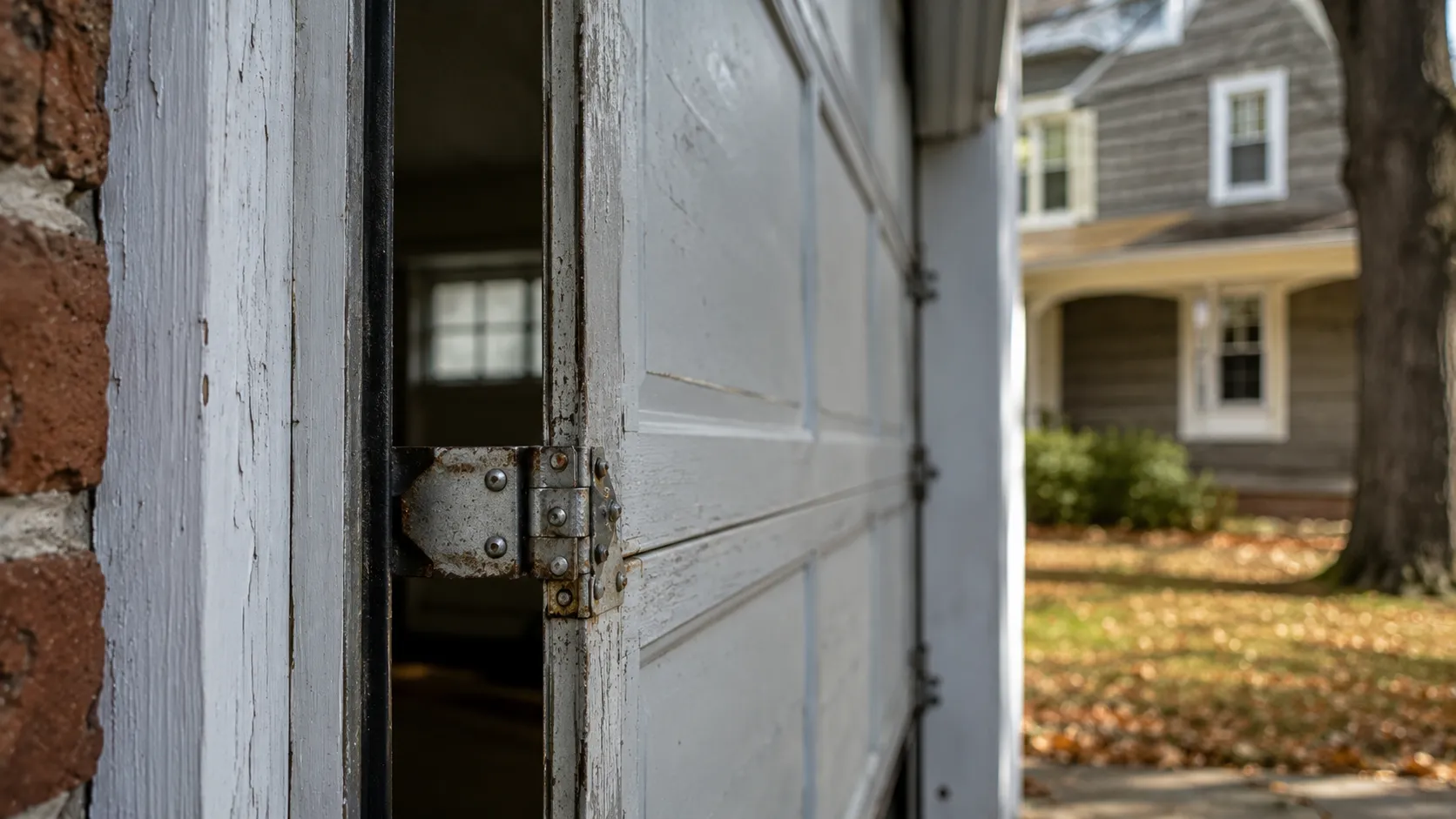
This area sits in a cold, moderate climate band, which means real freeze-thaw cycling every winter rather than one hard freeze that stays put. That cycling is hard on garage doors in a specific way: steel tracks contract in the cold and expand again on the thaw days, and over enough winters the bolts holding the track to the jamb work loose. On a door with 1970s-era hardware, that loosening shows up as a track that's slightly bowed rather than straight, which we check for on every call regardless of what the homeowner asked us out for.
Lubricant matters too - grease that's fine in summer stiffens up when temperatures drop, which is why a door that ran quiet in August can start grinding in January without anything actually breaking. Weatherstripping at the bottom seal also takes a beating from repeated freeze-thaw, cracking and letting cold air and moisture into the garage, which speeds up rust on cable ends and bottom brackets. We check the seal condition alongside the hardware, because on an older door those two problems tend to show up together, not separately.
What we find
When Waiting Is Fine
Not everything needs a same-day call. If your door is from that 1960s-70s wave of construction and it's just started making a new noise but still opens and closes on both photo-eye sensors without hesitation, you can usually wait a week or two to get it looked at rather than treating it as an emergency. A single stiff roller, a slightly slow close, or minor surface rust on a bracket that hasn't reached the cable itself are all things that get worse slowly, not overnight.
Here's the honest limit on that, though: once a spring shows visible gaps between coils, or a cable starts fraying at the drum, waiting isn't a maintenance choice anymore, it's a bet on which day it fails completely - and a full spring failure on an older torsion setup can bring the door down hard. We also can't always get exact replacement hardware for a door built before 2000 on short notice, since some of that older gauge track and drum sizing isn't something every supplier carries, so a repair on a door that old sometimes turns into a scheduling conversation, not a same-day fix.
How we work
What Is Going On
Put together, what we're usually looking at on a service call here is original or near-original torsion hardware from a house built sometime between 1938 and 2003, worn unevenly by decades of freeze-thaw cycling that this cold climate band produces every winter. That combination is why the failure pattern differs from what you'd see on a newer build across the region - it's slower, it's hardware-driven rather than opener-driven, and it tends to hit the track and spring before it hits the panel.
We work this area along with the nearby communities - Glen Ellyn, Winfield, Carol Stream, Glendale Heights, Lisle, and the towns further out toward Bartlett and Batavia - and the same 1960s-70s-era hardware pattern shows up across most of that stretch, which is part of why we check the same three things first on almost every call: spring and drum origin, track alignment, and seal condition. None of that is guesswork specific to one house; it's what decades of the same housing stock sitting in the same climate does, consistently.
Questions
Common questions
Why does my garage door make more noise in winter than summer?
Grease that lubricates smoothly in warm weather stiffens up when temperatures drop, and this area gets real freeze-thaw cycling all winter. That stiffening shows up as grinding or squealing on the rollers and hinges even when nothing is actually broken. It's usually a lubrication and track-alignment check, not a repair.
Is it normal for an older Wheaton-area garage to have mismatched hardware?
Yes. Houses in this area were mostly built in the 1960s and '70s, and it's common for the original torsion spring or drum to have been swapped out once over the decades without matching the rest of the setup. That mismatch is one of the most frequent things we find causing a door to lift unevenly.
How do I know if I can wait on a repair?
If the door still opens and closes evenly, both sensors work, and you're only hearing a new noise, you can usually wait a week or two. Once you see gaps opening in a spring's coils or fraying at a cable near the drum, that's not a wait-and-see situation anymore.
Do you always have replacement parts for an older door on hand?
Not always. Some gauge track and drum hardware sized for houses built before 2000 isn't something every supplier stocks, so a repair on an older door sometimes takes longer to schedule than a repair on a newer build. We'll tell you upfront if that's the case rather than guess.
Ready when you are
Need a garage door sorted in Wheaton?
Wheaton Garage Door Pros repairs and installs garage doors, springs and openers in Wheaton, IL and the surrounding area.