
Guide
What a Service Call Actually Covers in Wheaton
A Wheaton service call means checking springs, tracks, and openers against 1960s-70s hardware and cold-weather wear, not a generic once-over.
Local detail
What to Check
When we show up for a service call in Wheaton, we're not running a generic checklist. Most of the housing stock here dates from 1938 to 2003, with a median build year around 1976, which means a big share of the doors we look at still have the original torsion or extension hardware from that era. We check the spring tension first, because a spring sized for a door built in the 1970s is often undersized or fatigued for the door it's holding today.
Next is the track alignment - older tracks in this area were set for lighter door panels, and if a homeowner swapped in a heavier insulated door later without upgrading the track brackets, that's a rollout waiting to happen. We also check the opener's force settings and the condition of the cables and rollers. On a house built before the mid-1980s, the wiring for the opener is sometimes a later retrofit, and we check the gauge and the mounting rather than assume it matches current code.
None of this is exotic work. It's matching what's actually installed against what the door and the household are asking it to do now, which in a lot of Wheaton homes means gear that's been quietly aging for four or five decades.
The area
What the Weather Here Does to It
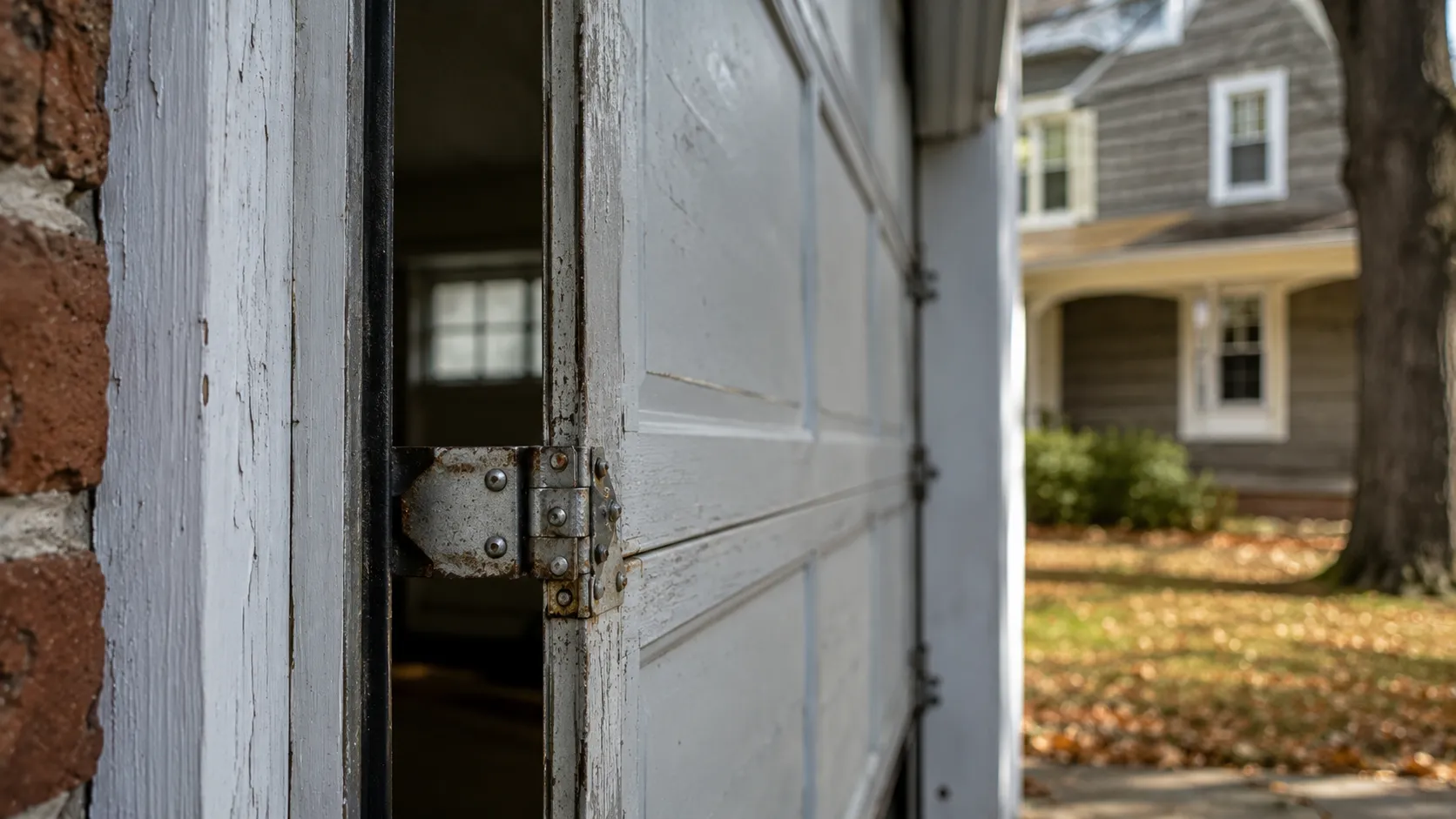
Wheaton sits in a cold, moderate climate band, and that shows up in specific ways on a garage door rather than as a vague seasonal complaint. Steel tracks and torsion springs contract in hard cold, which changes spring tension enough that a door balanced fine in August can bind or slam in January. We see it most on doors with the original 1970s-era torsion hardware, where decades of thermal cycling have already stressed the coil. Weatherstripping at the bottom panel is another cold-climate wear point - vinyl seals that were fine ten years ago crack and let cold air and salt-laden slush track into the garage, which then attacks cables and bottom brackets from below.
We don't oversell this. A door that's out of balance in winter isn't automatically a broken spring; sometimes it's just cold steel needing a tension adjustment, and that's a fifteen-minute fix, not a replacement. The honest answer is that cold doesn't create new problems as often as it exposes ones that were already there - a worn roller or a loose bracket that summer never stressed enough to reveal.
What we find
When Waiting Is Fine
Not every noise or hesitation means call today. If a door on an older torsion system is a little slow to close on the coldest mornings but runs fine by afternoon, that's the steel and the lubricant responding to temperature, not failure. If a roller squeaks but the door still travels straight and stops where it should, that's a maintenance item, not an emergency - grease it and watch it.
Where we tell people to wait: cosmetic panel dents that don't affect the track line, or an opener remote that's slow to sync but still works on a second try. Where we say don't wait: a spring that's visibly gapped or a cable that's frayed, because on a heavier insulated door those fail without much warning. Given that median household income in this service area runs near $97,861, a lot of homeowners have the option to fix things properly rather than patch them, and we'd rather tell someone their door is fine for another season than sell a call that isn't needed yet.
How we work
What Is Going On
Across the roughly 542,515 households and 263,398 owner-occupied houses in this service area, the pattern we see most is a mismatch between original-era hardware and how the door is used now - more cycles per day, heavier insulated panels swapped onto old tracks, openers added decades after the door itself. That mismatch, not any single dramatic failure, is what most service calls turn out to be about.
It's slower to diagnose than swapping a part on sight, but it's the difference between fixing the actual problem and fixing the symptom that shows up again in eight months. One limit worth being upfront about: if a torsion spring size or an opener logic board is discontinued for a door that old, we may need to order the part rather than have it on the truck, and that can mean a short wait rather than a same-visit fix.
Questions
Common questions
Why does my garage door stick in winter but not summer?
Cold steel loses tension, and torsion springs sized decades ago for a lighter door feel it first. On Wheaton's older housing stock, from the 1960s-70s wave especially, that seasonal tightening is common. Usually it's a tension adjustment, not a broken spring, but if the door binds hard rather than just slowing down, that's worth a call rather than waiting it out.
Is my door's hardware original if my house was built in the 1970s?
It's possible. A lot of Wheaton homes from that era still run torsion or extension springs installed with the original build, and the median build year here is around 1976. If nobody's mentioned a spring replacement, it's worth having the hardware checked rather than assuming it's been swapped.
How do I know if a noise is normal or a real problem?
A squeak that stays constant and the door still travels straight is usually just a dry roller - grease it and monitor. A grinding sound, a visible gap in the spring coil, or a frayed cable means stop using the door and call. The difference is whether the noise is changing or steady.
Ready when you are
Need a garage door sorted in Wheaton?
Wheaton Garage Door Pros repairs and installs garage doors, springs and openers in Wheaton, IL and the surrounding area.